Table of Contents
What is an SEO meta description?
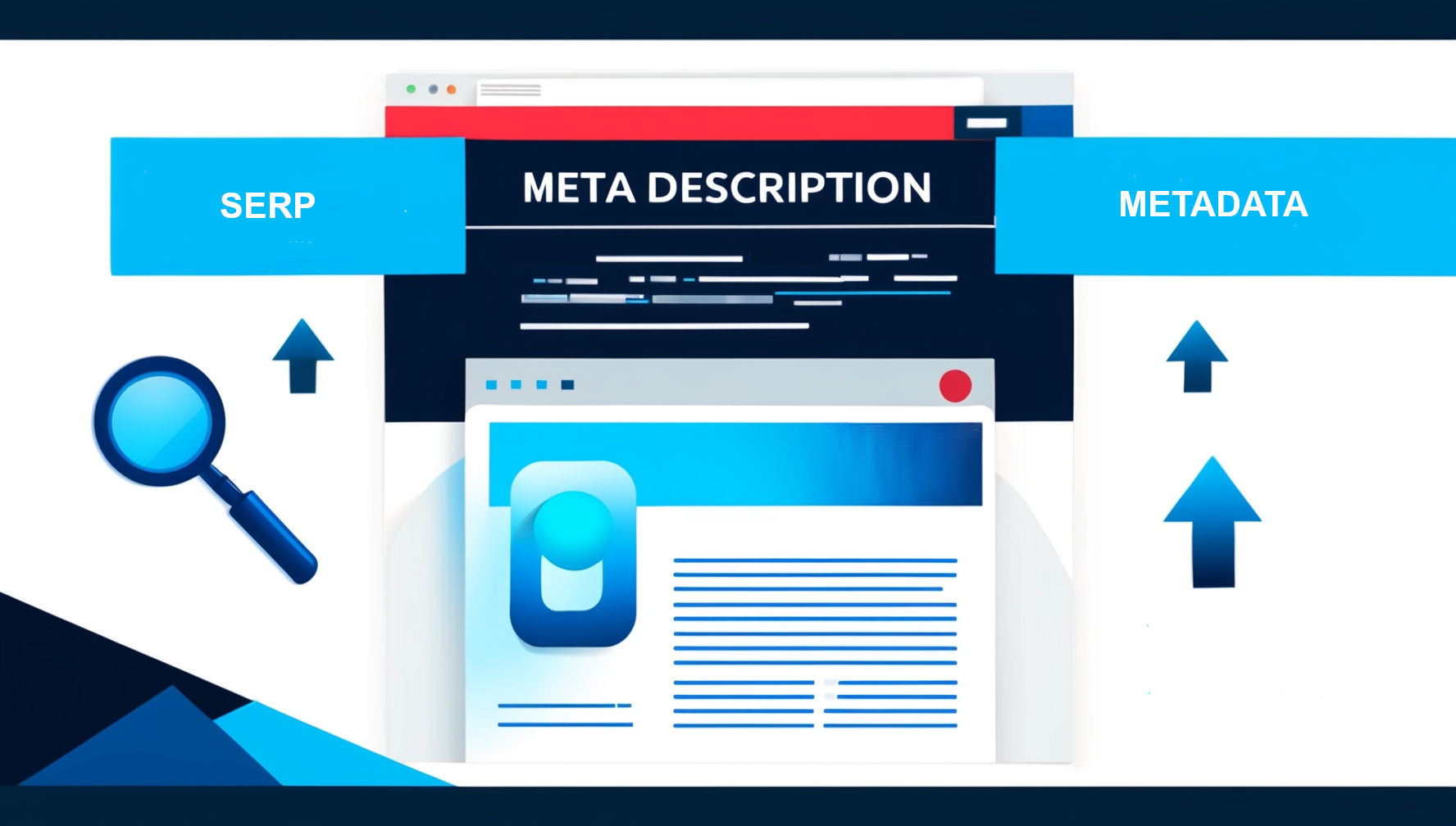
An SEO meta description is an HTML attribute that summarizes a webpage’s content. Appearing in search engine results pages (SERPs) beneath the title tag and URL, it serves as a snippet to entice users to click through to your site. While meta descriptions don’t directly influence search engine rankings, they significantly impact click-through rates, which can indirectly affect rankings.
Crafting a compelling meta description involves using relevant keywords naturally, as these terms are often bolded in SERPs, drawing user attention. The language should be convincing, incorporating persuasive phrases and clear calls to action to motivate users to visit the site. The meta description on each page should accurately reflect the page’s specific content and purpose. Avoid duplications, as they can confuse both users and search engines.
A well-written meta description is not just a mere formality but a strategic element of SEO that bridges the gap between search visibility and user engagement. It should offer a clear and enticing snapshot of what users can find on the page, highlighting unique selling points or benefits. This approach improves the likelihood of attracting clicks and boosts overall site traffic. Regularly updating and optimizing meta descriptions based on performance data is crucial to maintaining their effectiveness and relevance in a dynamic search landscape.
Technical implementation
- HTML tag:
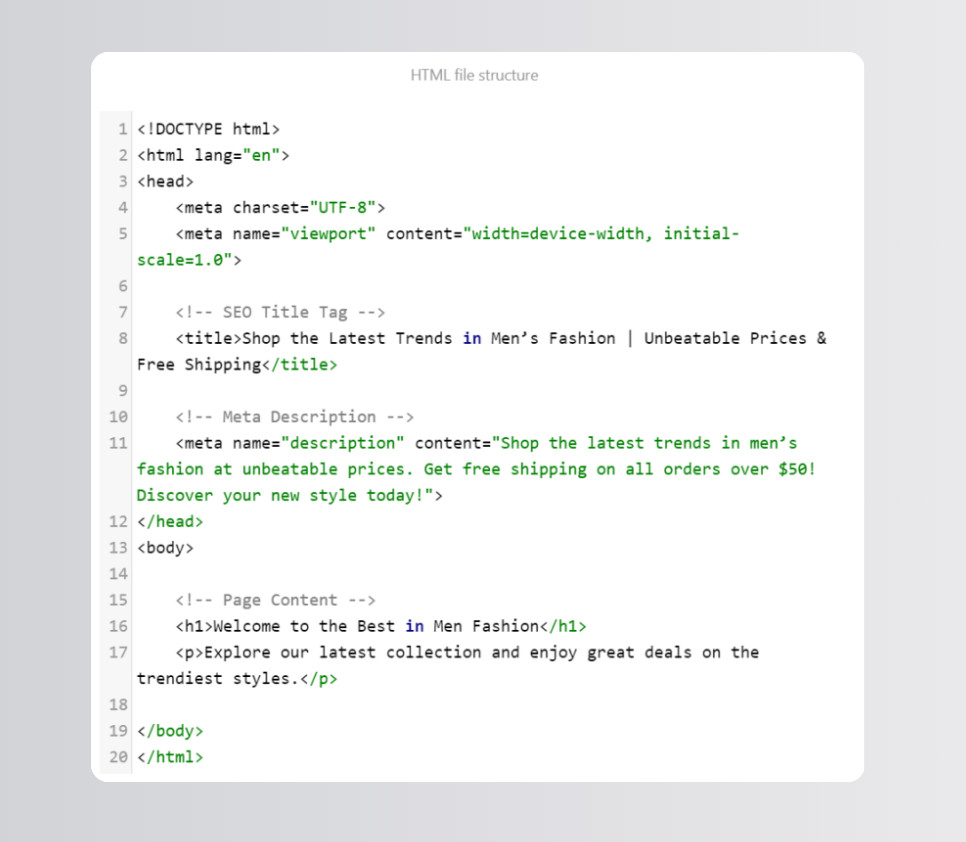
The meta description is added within your HTML code’s < head > section using the < meta > tag.
For example: < meta name= “description” content=” Shop the latest trends in men’s fashion at unbeatable prices. Get free shipping on all orders over $50! Discover your new style today!” >
- CMS integration:
Most content management systems (CMS), such as WordPress and Drupal, have built-in fields for meta descriptions. Plugins like Yoast SEO for WordPress make adding and editing meta descriptions easy.
Technical issues and how to avoid them
#1. Incorrect HTML tag implementation
If the meta description tag is not correctly implemented, search engines may not recognize it, resulting in the absence of the intended description in SERPs. So, ensure the meta description is correctly placed within your HTML code’s < head > section. Use the following format: < meta name= “description” content= “Your meta description here.” >
#2. Missing meta descriptions
Pages without meta descriptions rely on search engines to generate snippets, which may not reflect the page content accurately. So, ensure each page on your website has a unique and relevant meta description. Regularly audit your site to identify and fill in missing descriptions.
#3. Dynamic content issues
Websites with dynamic content (e.g., e-commerce sites with numerous product pages) might need help to generate unique SEO meta descriptions for each page. Use templated descriptions that include dynamic placeholders. For example, “Buy [Product Name]—Free Shipping on Orders Over $50!” This approach ensures that each product page has a unique yet relevant description.
#4. JavaScript-generated meta descriptions
Search engines may incorrectly crawl meta descriptions generated via JavaScript, leading to missing or incorrect snippets in SERPs. The solution: prefer server-side rendering for meta descriptions. If JavaScript is necessary, ensure it’s implemented so search engines can crawl and index properly.
Good vs. bad SEO meta descriptions, with examples

Bad meta descriptions
Example 1: Generic and vague
< meta name= “description” content=”Welcome to our site. We can provide a variety of services.” >
Why is it bad?
- It doesn’t specify what the site is about.
- No relevant keywords that indicate the content of the page.
- Fails to encourage users to take action.
Example 2: Keyword stuffing
< meta name= “description” content= “Cheap shoes, affordable shoes, discounted shoes, buy shoes online, best shoes deals.” >
Why is it bad?
- Overloaded with keywords, making it look spammy.
- Reads poorly and is unappealing to users.
- Doesn’t explain the benefits or unique features of the products.
Example 3: Too long
< meta name= “description” content=” At XYZ Company, we specialize in providing our clients with various top-notch services and products. We aim to ensure continuous customer satisfaction through excellent service and high-quality products. Visit our website to learn more about what we offer.” >
Why is it bad?
- Exceeds the recommended 150-160 character limit and will be truncated in SERPs.
- Doesn’t highlight key points concisely.
- Too general and not enticing.
Example 4: Misleading
< meta name= “description” content=” Learn how to make delicious recipes at home with our professional chefs.” >
Why is it bad?
- If the page is about something other than cooking or recipes, this will lead to high bounce rates.
- Misleading descriptions can damage trust and lead to poor user experience.
Good meta descriptions
Example 1: E-commerce product page
< meta name= “description” content=”Shop the latest trends in men’s fashion at unbeatable prices. Enjoy free shipping today on all orders over $30. Discover your new style now!” >
Why is it good?
- Clearly describes what the page offers.
- Includes relevant keywords like “men’s fashion” and “free shipping.”
- Encourages users to “Discover your new style today!”
Example 2: Blog post
< meta name= “description” content=” Learn the top 10 strategies for improving your SEO in 2024. Our detailed guide covers the latest trends and includes tips to boost your website’s traffic.” >
Why is it good?
- Directly addresses the blog post’s content.
- Uses relevant keywords like “SEO strategies” and “boost your website’s traffic.”
- Highlights the benefits of reading the post (comprehensive guide, latest trends, and tips).
Example 3: Service page
< meta name= “description” content=” Looking for reliable home cleaning services? Our expert team offers thorough, eco-friendly cleaning solutions. Book your appointment now!” >
Why is it good?
- Matches what users searching for home cleaning services might be looking for.
- Includes keywords like “home cleaning services” and “eco-friendly cleaning solutions.”
- “Book your appointment now!” prompts users to take action.
Example 4: Product category page
< meta name= “description” content=” Explore our wide selection of organic skincare products. Safe, natural, and effective solutions for all skin types. Shop now and enjoy exclusive discounts!” >
Why is it good?
- Clearly describes the range of products offered.
- Uses relevant keywords like “organic skincare products” and “natural solutions.”
- “Shop now and enjoy exclusive discounts!” encourages users to act immediately.
Checklist: How to craft an effective SEO meta description
Here’s a list of elements you need to craft an effective meta description:
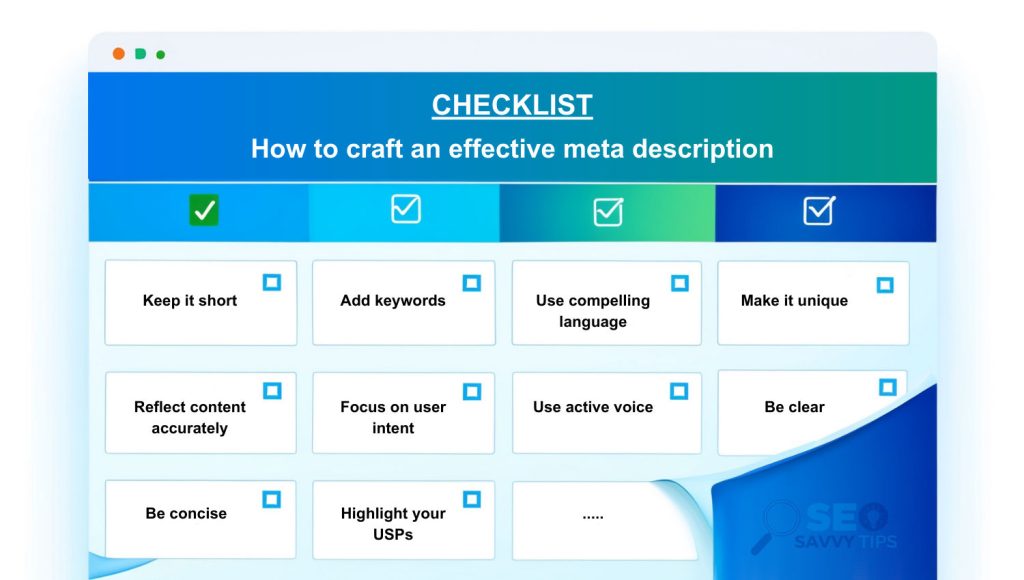
Keep the length up to 160 chars
A meta description’s optimal length is 160 characters. This length ensures the entire description is visible in SERPs without getting cut off. Too long descriptions may be truncated, resulting in incomplete information being displayed to users.
Different search engines may display varying lengths of meta descriptions. Google, for instance, typically shows up to 160 characters, while Bing might show slightly more or less.
Furthermore, the exact number of characters displayed in a snippet depends on factors such as:
- Width of the characters (e.g., an “w” uses more pixels than an “e”)
- User’s device (e.g., there’s less space on a mobile than on a desktop)
- User’s search query (i.e., bolded words take up more pixels)
Therefore, staying within the 150-160 character range is a good practice to ensure consistency across platforms.
A practical example is: “Discover the latest trends in men’s fashion. Shop now and enjoy free delivery on all orders over $50!“
Add keywords
Incorporate keywords that reflect the main topic of the webpage. These keywords should naturally fit into the description rather than being forced or overly repeated. Note that keywords that match the user’s search query are often bolded in the SERPs, which can draw the user’s eye and increase the likelihood of a click.
Practical example: “Learn SEO strategies to boost your website traffic in 2024. Expert tips and tricks to get you ahead.“
Use compelling language
Use action-oriented language and persuasive phrases to encourage users to click. Words like “discover,” “learn,” “get,” “explore,” and “find out” can motivate users. A clear call-to-action (CTA) can further help guide users on what to do next. CTAs are imperative sentences that start with a verb and encourage readers to act. Phrases like “Shop now,” “Read more,” or “Get started today” can be effective.
Additionally, highlight the benefits users will gain by clicking on the link. This could be savings, learning something new, or finding a solution to their problem.
Practical examples:
- “Shop our exclusive collection of handmade jewelry. Unique designs, great prices. Get yours today!“
- “Join our newsletter for exclusive health tips. Subscribe today for your free guide.“
Make it unique
Each page on your site should have a unique meta description that accurately represents its content. This prevents duplication issues and ensures each page is individually optimized for search engines. Duplicate meta descriptions can result in a poor user experience and might be flagged by search engines, negatively impacting your site’s SEO performance. Tools like Screaming Frog SEO Spider or Google Search Console can help you identify duplicate meta descriptions.
Tailoring the description to each page’s specific content makes it more relevant and appealing to users searching for that particular topic.
A practical example for a blog post on SEO is “Discover essential SEO tips to improve your website’s visibility. Learn from experts and stay ahead in 2024.“
Reflect content accurately
The SEO meta description should be a concise summary of the page content. Misleading descriptions can lead to low engagement and high bounce rates, as users may leave the page quickly if it doesn’t meet their expectations.
Accurate descriptions build trust with users, encouraging them to explore more of your site. Thus, ensure that the description is honest and aligns well with the content on the page.
A practical example for a service page on cleaning services is “Professional home cleaning services. Eco-friendly and reliable. Book your appointment online today.“
Focus on user intent
Know what your audience is searching for and tailor the meta description to meet those needs. This involves understanding the search intent behind the keywords. Also, highlight solutions to common problems or needs that your target audience might have. And if possible, personalize the description to speak directly to the user’s query or needs.
Practical example: “Looking for fast and reliable tech support? Our 24/7 service guarantees your issues are resolved quickly.“
Use active voice
The active voice is direct and more engaging, making the SEO meta description more compelling. It also tends to be clearer and more concise than the passive voice, helping improve readability. For instance, instead of “The best tools are found here,” use “Find the best tools here.”
Practical example: “Discover top-rated hiking gear for your next adventure. Shop now and save!“
Be clear and concise
Avoid jargon or complex language that might confuse users. Ensure that the meta description is easy to read and understand at a glance, even by non-native English speakers. Focus on delivering the essential information users need to decide whether to click.
Practical example: “Affordable web design services for small businesses. Get a professional website today.“
Highlight your unique selling points
Use the SEO meta description to emphasize what makes your page or product unique compared to competitors. Clearly state the benefits and unique features you offer. Showcase any competitive advantages, such as special offers, unique products, or exceptional service. For instance, “Experience gourmet dining with our exclusive chef’s menu. Book your table for a culinary delight.“
Furthermore, a good meta description for an e-com product page should include the following product information:
- name and model number
- price and any temporary offers or discounts
- key features and benefits
- in-stock availability
- shipping options
By including these product details, you can make your meta description relevant and appealing to potential customers.
Overall, effective meta descriptions are a blend of relevance, persuasion, and accuracy. By focusing on all these key elements, you can craft descriptions that attract clicks, enhance the overall user experience, and contribute to your site’s SEO success.
Common mistakes to avoid
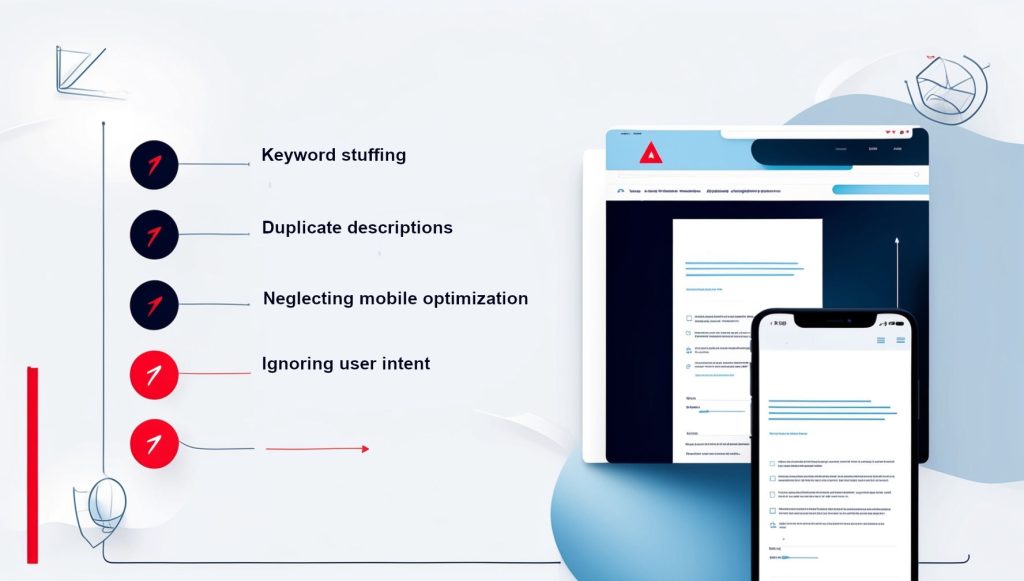
- Keyword stuffing
Overloading the meta description with keywords can make it look spammy and reduce readability. Search engines might also flag it as manipulative. Instead, use keywords naturally and sparingly. Focus on making the meta description informative and engaging rather than stuffing it with keywords.
- Too long or too short descriptions
Descriptions that are too long (more than 160 chars) will be truncated, and those that are too short (less than 120 chars) may not provide enough information.
- Duplicate descriptions
Using the same meta description for multiple pages can confuse search engines and users. Thus, make sure that each page has a unique description reflecting its content.
- Irrelevant meta descriptions
Descriptions that do not accurately reflect the page’s content can lead to high bounce rates, as users leave quickly when they don’t find what they expected. To avoid such issues, ensure the SEO meta description accurately summarizes the page content. Regularly review and update descriptions to maintain relevance.
- Generic or vague descriptions
Vague descriptions like “Welcome to our site” or “Home” provide little value and do not entice users to click. Instead, write specific and detailed meta descriptions that clearly communicate the unique value of the page.
- Neglecting mobile optimization
Descriptions that aren’t optimized for mobile can negatively impact CTR. Thus, ensure the most important information is at the beginning of the meta description, as mobile screens show fewer characters. Test how your descriptions appear on mobile devices.
- Ignoring user intent
Focusing solely on what you want to communicate rather than what users search for can result in lower engagement. Instead, research user intent and tailor your meta descriptions to address the needs and queries of your target audience.
- Overuse of symbols and special characters
Excessive use of symbols and special characters can make the description difficult to read and may not be displayed correctly in all browsers or search engines. To avoid such issues, use symbols and special characters sparingly. Stick to clear and simple language that is universally readable.
Best practices for monitoring and maintaining SEO meta descriptions

#1. Conduct site audits
Regular site audits are essential for ensuring that your SEO meta descriptions remain effective and up-to-date. This process involves systematically reviewing and optimizing the meta descriptions across your website to enhance SEO performance and user engagement.
To conduct a thorough audit, employ SEO tools that can crawl your website and generate reports on various SEO elements, including meta descriptions. Tools like Screaming Frog SEO Spider, Ahrefs, SEMrush, and Google Search Console are particularly useful. These tools can help you identify pages with missing, duplicate, or underperforming meta descriptions.
#2. Performance analysis
Leverage tools like Google Search Console to monitor the performance of your meta descriptions. Pay attention to metrics such as click-through rates (CTR), impressions, and average position. Pages with low CTR despite high impressions might have ineffective meta descriptions. Analyze these pages to determine if the descriptions can be made more compelling or relevant to improve CTR.
#3. Test different versions
Do A/B tests on different versions of your meta descriptions to find out which ones perform better. Testing different phrases, CTAs, or keyword placements can provide you with insights into what resonates most with your audience. Based on the results, iterate and refine your SEO meta descriptions to improve performance continuously. Use tools like Google Optimize to conduct experiments and gather data on user engagement.
#4. Use CMS plugins
Content Management System (CMS) plugins like Yoast SEO for WordPress are invaluable tools for efficiently managing, monitoring, and optimizing meta descriptions. These plugins streamline the process by providing features such as user-friendly interfaces, automated suggestions, bulk-editing capabilities, error detection and resolution, and detailed analytics.
#5. Follow SEO trends
SEO is an evolving field. Maintain a documented set of best practices for creating and auditing meta descriptions. This documentation should be updated regularly based on the latest SEO trends and performance data. Training your content and SEO teams on these best practices ensures consistency and effectiveness in maintaining your meta descriptions.
By following these best practices for regular audits, you can maintain high-quality meta descriptions that enhance your SEO strategy, improve user engagement, and drive more traffic to your website. Regularly monitoring and optimizing meta descriptions ensures they remain relevant, compelling, and aligned with both search engine guidelines and user expectations.
In conclusion
While not a direct ranking factor, SEO meta descriptions are vital for improving CTR and user experience. Effective meta descriptions require understanding user intent, being concise and clear, and continuously monitoring performance. By paying attention to these elements, you can significantly impact your site’s visibility and attractiveness in search engine results.
By following these guidelines and learning from both good and bad examples, you can craft meta descriptions that improve user engagement, increase click-through rates, and enhance your overall SEO strategy.