
Analyzing your SERP competitors is crucial to gaining insights into the competitive landscape and shaping your SEO strategy effectively. Follow these steps to get a clear picture of who you’re up against and how to improve your search presence.
Table of Contents
Step 1: Identify relevant keywords
The first step in a SERP competitors’ analysis is gathering a strong set of keywords. This list will be your roadmap, directing your analysis and providing insights into which search terms your audience uses to find content like yours. Here’s one way to approach keyword research.
Define your content objective
Start by defining the purpose of the content you’re analyzing or planning to create. The type of content – whether a product page, blog post, or landing page – will influence the type of keywords you choose. For example:
- Transactional and commercial keywords are ideal for product or service pages. These may include phrases like “buy,” “discount,” or specific product names.
- Informational keywords work well for blog posts or guides, focusing on questions or phrases like “how to,” “what is,” or “tips for.”
Understanding the search intent behind each type of keyword will help you create a targeted list.
Brainstorm and list seed keywords
Seed keywords are the broad, foundational terms that capture the essence of your topic. Begin by jotting down a few general terms that describe your industry or product. For example, if you’re creating content about project management tools, your seed keywords might include “project management software,” “task tracking,” or “online collaboration tool.”
These will guide your search for more specific terms and help you discover long-tail keywords in the next steps.
Use keyword research tools
Keyword research tools like SEMrush, Google Keyword Planner, Ahrefs, or Moz can help expand your list with related and long-tail keywords. Here’s how to make the most of these tools:
- Explore related terms – enter your seed keywords into the tool, and it will suggest associated phrases and popular variations.
- Check search volume and competition level – prioritize keywords with decent search volume and low to moderate competition, especially if you aim to rank new or less authoritative content.
- Look for keyword intent alignment – many tools allow you to filter by keyword intent (e.g., informational, commercial). This can help you sort keywords based on the content type you’re creating.
A well-rounded keyword list should include both broad and specific terms, covering various levels of search intent.
Analyze search results for keyword ideas
Enter your primary keywords into the search engine and examine the top results. Take note of:
- Common phrases in title tags and headings – these often indicate high-value keywords.
- Relevant long-tail keywords – look for specific phrases or niche queries your competitors use.
Using this information, you can identify keywords that help competitors rank well and may align with your content goals.
Refine and organize your keyword list
After gathering a comprehensive set of keywords, narrow it down by prioritizing those that are:
- Relevant – make sure each keyword directly relates to your content goals.
- Achievable – focus on keywords with competition levels that match your site’s authority.
- Varied – include a mix of head terms (broader, high-volume keywords) and long-tail keywords (specific, lower-volume keywords that are easier to rank for).
Organize your refined keywords by intent or content type, creating clusters that you can use to structure your analysis. This final list will be the foundation for reviewing SERP competitors and planning your SEO strategy.
Step 2: Review top organic results
After building a relevant keyword list, it’s time to analyze the top-performing pages in search results. This step is vital because it gives you a deep understanding of what’s working for competitors in your niche.
First, for each keyword in your list, search for the top organic results in your target region. Focus on the first page, especially the top five results and the last result on page one. These positions offer the most insights into effective strategies since they capture the most organic search traffic. Avoid sponsored content or ads since they aren’t purely organic and may skew your findings.
Then, document key details in a spreadsheet (FREE template). Creating a well-organized spreadsheet will help you compare and analyze your competitors efficiently. Here are the essential details to include for each ranking page:
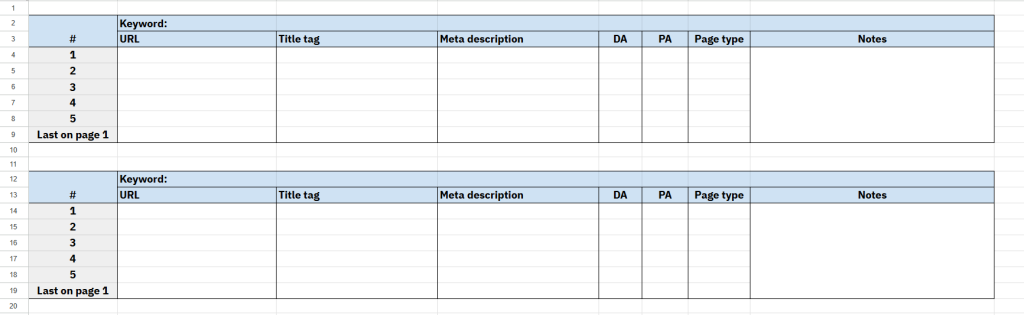
- Page type – note if the ranking page is a product page, blog post, category page, or something else. This provides insight into what type of content Google prefers for each keyword.
- Title tag – record the title tag exactly as it appears in the search results. Look for keyword usage, power words, and any modifiers (e.g., “Best,” “2024”) that make the title stand out. Title tags reveal the primary keyword focus and emotional appeal the page uses to attract clicks.
- URL – observe how keywords are incorporated into the URL structure. URLs that include keywords can indicate relevance, but also watch for clarity and conciseness, as these contribute to user trust and SEO.
- Meta description – copy the meta description and evaluate how well it communicates value. Does it contain the keyword? Is it enticing? A strong meta description influences CTRs and gives clues about messaging and tone that resonate with searchers.
- Domain Authority (DA) and Page Authority (PA) – use tools like Moz, Ahrefs, or SEMrush to find each page’s DA and PA. Higher scores indicate stronger authority and credibility, helping you understand how established the competing sites are.
- Backlinks – check the number of backlinks pointing to each page. Backlinks signal authority and content value. So, pages with a high backlink count are often difficult to outrank unless your content is exceptional.
Gathering these insights will help you recognize the strengths and weaknesses of each competing page.
Step 3: Review collected data
With your SERP competitors’ data compiled, the next step is to review the content types that are ranking well for each keyword. This will help you figure out which content formats and structures Google favors for specific search intents, allowing you to align your strategy accordingly. Here’s a detailed look at how to approach this step.
Identify the content type ranking for each keyword
For each keyword in your spreadsheet, review the pages that consistently rank in the top positions. Take note of the primary content type(s) for each keyword, such as:
- Blog post – often ranks for informational or educational queries, like “how-to” guides, “tips,” or “what is” articles.
- Product page – common for transactional keywords where users may be looking to make a purchase or learn about specific products.
- Category or service page – often ranks for broad commercial keywords, providing an overview of multiple products, services, or offerings.
- Downloadable PDF files – sometimes used by industry resources or educational sites, PDF files can rank well for certain transactional or informational queries.
- Landing pages – these are often seen for high-intent commercial queries and usually lead directly to a conversion goal like signup or purchase.
By categorizing the content type for each keyword, you’ll gain insight into the types of pages Google considers relevant for different search intents. This information will help you match your content type to what’s proven effective for each keyword.
Filter out authority sites as non-competitive
As you analyze, you may notice certain high-authority sites like Wikipedia, Academia.edu, or government websites ranking for multiple keywords. While these pages may hold strong positions, they’re generally not realistic targets for competitive analysis because of:
- High Domain Authority – sites like these have extremely high domain authority, making them difficult or nearly impossible to outrank.
- Broad, general content – their content may not be specific enough to your niche or user intent, so they won’t provide direct insights for optimizing your site.
Exclude these domains from your main list of SERP competitors. Instead, treat them as informational references for general knowledge rather than as direct competition for rankings.
Note downloadable PDFs and industry-specific resources
For some keywords, you may also notice that downloadable PDF files or industry reports from professional associations, universities, or public databases are ranked in the top positions. These file types are common in certain niches, especially for technical, research-heavy, or industry-specific queries.
While they’re useful resources, don’t include PDFs or static documents as main competitors in your analysis. Here’s why:
- Limited user engagement – PDFs often lack the interactive, SEO-optimized structure of web pages and are harder to replicate as competing content.
- Specific use cases – these files often serve a niche purpose, such as providing technical documentation or reference material, which may not align with your content goals.
However, take note if PDF results appear frequently in the top rankings for any keyword. This could signal that users seek downloadable resources or in-depth, easily accessible guides, which may influence your decision to create downloadable assets as part of your content strategy.
Look for trends in content types across keywords
Once you’ve documented the content types for each keyword, examine the data to spot trends:
- Informational keywords – if blog posts consistently rank for informational keywords, this suggests that users (and search engines) favor comprehensive, educational content for these queries.
- Transactional keywords – if product or service pages rank well for transactional keywords, prioritize these formats for any keywords where your goal is to drive sales or conversions.
Identifying these trends ensures your content aligns with search intent, which increases your chances of ranking higher in the SERPs. It also helps you spot potential opportunities – if most competitors use product pages for certain keywords, creating a detailed comparison guide could set your content apart.
Step 4: Group SERP competitors
Now, it’s time to identify the most consistent players in your space. Grouping competitors based on their ranking frequency across keywords – and factoring in content type – reveals which sites dominate the SERP landscape for your target queries. This analysis helps you pinpoint the top competitors you need to focus on in the next steps.
Count each competitor’s appearances across keywords
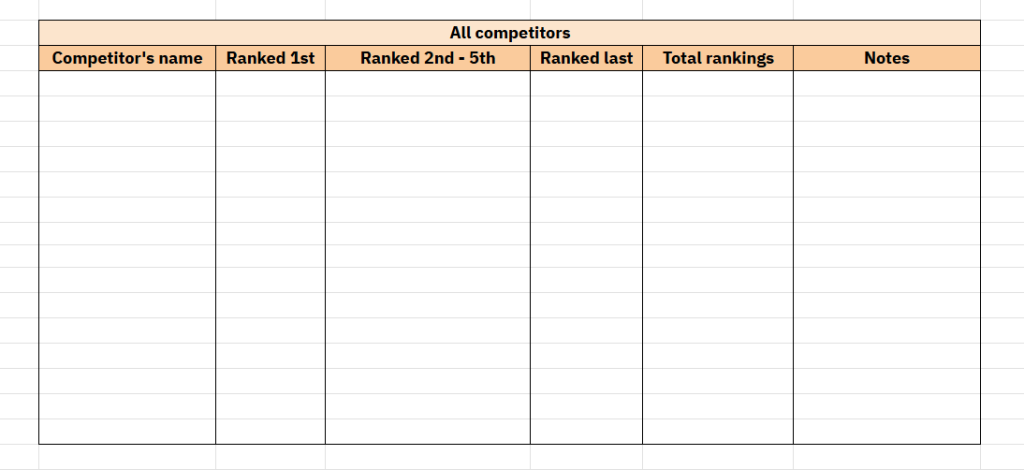
For each keyword, review your spreadsheet to see how often each domain ranks on page one. Note down every occurrence where a domain ranks, whether in the top five or lower on the page. This frequency count will help you identify sites that frequently rank across multiple keywords. For instance:
- If Competitor A ranks for 12 out of 15 keywords, they’re a high-frequency competitor and should be a primary focus.
- Competitor B, who only ranks for three keywords, would be a low-frequency competitor and might be less relevant for direct analysis.
However, if Competitor B ranks consistently with the same content type you’re targeting (e.g., blog posts for informational keywords), they may still be worth examining for specific insights.
Group SERP competitors by frequency of appearance and content type
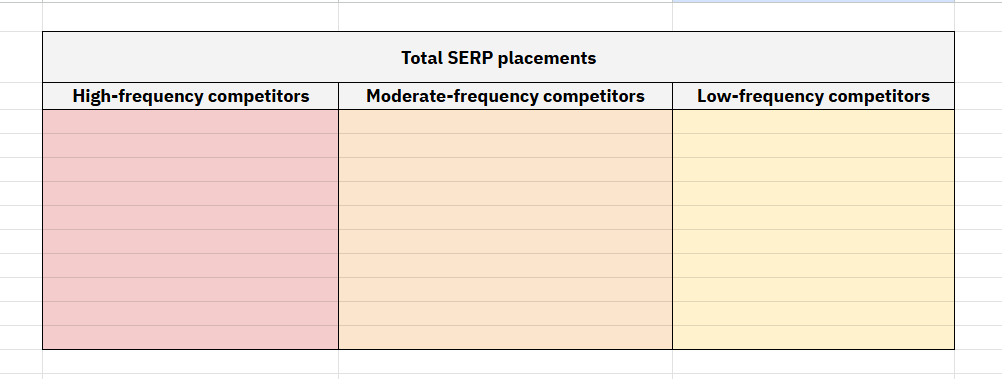
Organize competitors into groups based on their ranking frequency and the type of content they use. Here’s a suggested grouping structure:
- High-frequency competitors – these domains rank consistently across many of your keywords and typically use the same content type you plan to create. For example, if you’re targeting blog posts for informational keywords, prioritize competitors who frequently rank with similar blog content.
- Moderate-frequency competitors – these competitors rank often, but perhaps with mixed content types. For example, they may use a blend of product pages and category pages if you’re targeting transactional keywords. They’re still valuable to analyze, especially for keyword overlap.
- Low-frequency competitors – sites that appear infrequently in rankings, often with less relevant content types, may be less essential for immediate analysis. However, if they rank for specific keywords with unique content types – like downloadable guides for research-heavy keywords – they might offer insights on niche opportunities.
This grouping helps you distinguish between competitors and lets you focus your analysis on the ones that align with your SEO goals.
Step 5: Finalize the list of SERP competitors
After completing all the above steps, document your top three to five SERP competitors for the content type you’re targeting (e.g., blog post, product page). If your content is a product page and your keywords include transactional or commercial queries, focus on competitors ranking with similar pages. However, if you plan a blog post targeting informational queries, prioritize competitors with well-performing blog content.
This targeted list will serve as the foundation for deeper competitor content analysis, which will examine how your competitors structure their pages, the topics they cover, and the keywords they target. You’ll also want to review their user engagement features, such as CTAs, visuals, and other elements that enhance their content.
In conclusion
To perform an effective organic SERP competitor analysis, follow the key steps outlined above. By completing them, you’ll gain actionable insights into how to refine your content strategy to meet search intent and outperform key competitors.