
Analyzing search queries is a fundamental step in understanding user search intent. It involves examining the keywords and phrases users enter into search engines to uncover what they are really looking for.
Here’s a detailed breakdown of how to analyze search queries effectively.
Table of Contents
1. Perform a keyword analysis
Getting the right keywords is like finding the perfect ingredients for a recipe.
Start by identifying the keywords users are searching for. This includes:
- Primary keywords – Core terms (e.g., “best running shoes”)
- Long-tail keywords – More specific phrases (e.g., “best running shoes for flat feet”)
- Variations and synonyms – Different ways of saying the same thing (e.g., “best fitness trackers” vs. “top fitness trackers”)
Different keywords can reveal subtle differences in user intent, so don’t overlook these variations.
Next, understand the context in which keywords are used. For example, “buy running shoes” suggests a transactional intent, meaning users are ready to purchase. On the other hand, “running shoes reviews” indicates a commercial investigation, where users are researching before buying. Look beyond individual keywords to the entire query, like “how to choose the best running shoes,” which shows users are seeking guidance and might be in an informational phase.
Classify keywords by intent to refine your strategy:
- Informational – Keywords like “how to,” “what is,” “guide,” and “tips” are used when users want to learn something.
- Navigational – Brand names or specific site references help users find particular websites.
- Transactional – Terms like “buy,” “discount,” “purchase,” and “deal” are used when users are ready to make a purchase.
- Commercial (investigation) – Keywords such as “best,” “top,” “review,” and “comparison” are used by users to compare products or services before deciding.
Finally, use keyword research tools like SEMrush, Google Keyword Planner, or Ahrefs to gauge search volume and trends. High search volume usually means strong user interest. Also, keep an eye on trends over time and seasonal variations, like peak times for “Christmas gift ideas,” to better plan your content.
2. Analyze search queries
Understanding different types of keyword queries can help you create content that really hits the mark. Each type of query reveals distinct aspects of what users are looking for online, and tailoring your content accordingly can significantly enhance its relevance and effectiveness.
Exact match search queries
Exact match queries are searches that use precise terms or phrases. They directly align with what users seek and usually reflect a strong intent. Here’s an example:
- Query: “buy organic coffee”
- Intent: Users are ready to buy.
For exact match queries, ensure your content or product page is optimized for conversions. This means having clear, persuasive calls-to-action, straightforward product descriptions, and an easy-to-navigate purchasing process. Highlight product features, benefits, and pricing. Ensure users can easily find the information and complete the purchase.
In addition, use exact match keywords in titles, meta descriptions, and throughout the content. Ensure that your product or service page is structured to directly answer the user’s intent.
Long-tail keywords
Long-tail keywords are longer, more detailed phrases that often indicate a more specific search intent. They typically have lower search volume but face less competition, making them valuable for targeting niche audiences. Here’s an example:
- Query: “best organic coffee for cold brew”
- Intent: Users are looking for specific recommendations or advice related to cold brew coffee.
Develop content that addresses the specific needs or questions the long-tail keyword indicates. For example, a blog post or guide titled “Top 5 organic coffees perfect for cold brew” would cater directly to this query. Ensure that you provide in-depth information that answers the specific aspects of the query, such as brewing tips or flavor profiles.
Regarding SEO, include long-tail keywords naturally within your content, headers, and meta descriptions. Long-tail keywords can also improve internal linking by linking to related content.
Question-based search queries
Question-based queries are framed as questions and often reflect users’ desire for information or solutions. These queries are typically longer and more detailed – for example:
- Query: “What are the benefits of organic coffee?”
- Intent: Users seek detailed information or answers to specific questions.
To address such queries, craft content such as FAQs, how-to guides, and detailed articles that answer these questions comprehensively. For instance, an article titled “10 benefits of drinking organic coffee” would directly address this query.
Implement structured data to improve your chances of appearing in featured snippets or answer boxes. And, optimize content for question-based keywords by including the question in headings and throughout the body. Consider using natural language to align with how people phrase their queries.
Prepositional search queries
Prepositional queries include specific prepositions or phrases that clarify the context or scope of the search. These queries often indicate a particular need or condition – for example:
- Query: “running shoes for flat feet”
- Intent: Users are looking for running shoes that specifically cater to flat feet.
Create content that directly addresses the specific context or condition the prepositional phrase indicates. For example, a guide on “Best running shoes for flat feet” should focus on recommendations and features that cater to this need.
For queries with geographical modifiers, such as “coffee shops near me,” ensure your content is optimized for local SEO. Include local business listings, reviews, and location-specific keywords. And don’t forget to use prepositional phrases in titles, headers, and throughout the content to ensure your content is relevant to these types of searches. Enhance content with specific details that match the query’s context.
3. Follow with a keyword modifier analysis
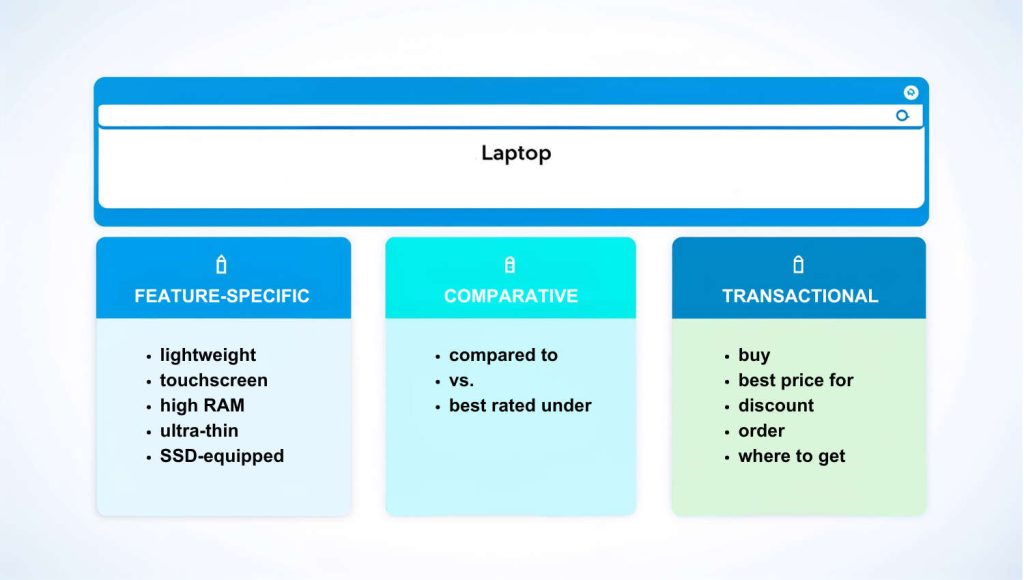
Keyword modifiers are words or phrases that add specificity to a search query, helping to refine and clarify the user’s intent. Understanding and analyzing these modifiers can significantly enhance your SEO strategy by letting you create content that precisely meets user needs.
Keyword modifier types
Common types of keyword modifiers include:
- Quality modifiers:
- “Best”: Indicates users are looking for top recommendations (e.g., “best budget laptops”).
- “Top”: Similar to “best,” but can sometimes suggest a list format (e.g., “top 10 travel destinations”).
- Price modifiers:
- “Cheap”: Focuses on affordability (e.g., “cheap flights to New York”).
- “Affordable”: Similar to “cheap,” but often used in a more positive context (e.g., “affordable wedding venues”).
- Transactional modifiers:
- “Buy”: Indicates readiness to purchase (e.g., “buy iPhone 14”).
- “Discount”: Suggests users are looking for deals or savings (e.g., “discount furniture stores”).
- Review modifiers:
- “Reviews”: Users seek user feedback and opinions (e.g., “laptop reviews 2024”).
- “Ratings”: Similar to “reviews” but focuses more on scores (e.g., “best-rated vacuum cleaners”).
- Comparative modifiers:
- “Vs”: Users are comparing two or more items (e.g., “iPhone 14 vs Galaxy S23”).
- “Compare”: Indicates a comparison search (e.g., “compare electric cars 2024”).
- Feature-specific modifiers:
- “Waterproof”: Users looking for specific features (e.g., “waterproof smartphones”).
- “With”: Searching for items with certain attributes (e.g., “laptops with SSD”).
- Geographical modifiers:
- “Near me”: Local searches (e.g., “restaurants near me”).
- “In [location]”: Searches specific to a location (e.g., “best gyms in London”).
Analyzing the impact of modifiers
Modifiers can alter the meaning of a query, shifting the user’s intent. For instance, “best budget smartphones” aims at high-quality, affordable options, while “cheap smartphones” focuses more on price.
To understand search volume and competition, use tools like Google Keyword Planner or SEMrush to determine the search volume and competition level for modified queries. A high search volume with low competition indicates a good opportunity for targeted content. It’s also crucial to track metrics such as click-through, bounce, and conversion rates for pages optimized for different modifiers. Analyzing these metrics helps identify which modifiers lead to higher engagement and conversions.
Optimizing content for keyword modifiers
Optimizing content for keyword modifiers involves several strategies. For content creation, use:
- Quality modifiers to create listicles, reviews, and detailed guides, such as “Top 10 best budget laptops for students.”
- Price modifiers to focus on affordability with comparisons and budget-friendly tips like “How to find cheap flights during the holidays.”
- Transactional modifiers to optimize product pages and include clear call-to-actions, such as “Buy iPhone 14 now – limited time offer!”
- Review modifiers call for developing review articles, testimonials, and ratings, such as “2024 car reviews: Top picks and ratings.”
Regarding on-page SEO, incorporate modifiers naturally into titles, headings, meta descriptions, and content. Use structured data (schema markup) to enhance search engine understanding and presentation in search results. For content structuring, comparative modifiers are effective when using tables and side-by-side comparisons, like “iPhone 14 vs Galaxy S23: Which is better?” Feature-specific modifiers should highlight specific features prominently, such as “Top waterproof smartphones for 2024.”
Lastly, for local SEO, optimize for geographical modifiers by including location-specific keywords and ensuring your business listings have accurate and up-to-date information on platforms like Google My Business.
4. Examine query patterns
Understanding query patterns helps you stay ahead of search trends and user preferences. By examining these patterns, you can refine your SEO efforts, align your content with user needs, and improve engagement. Let’s see how you can approach the analysis of query patterns:
Identify rising trends
Rising trends refer to search queries that are gaining popularity over time. Identifying this type of trends allows you to capitalize on emerging topics before they become mainstream. Here’s what you need to do:
- Use Google Trends to analyze search interest over time. This tool shows how search volume for specific queries changes, helping you spot emerging topics and seasonal spikes.
- Platforms like Twitter, Instagram, and TikTok often reveal trending topics and hashtags. Monitoring these can provide insights into what’s gaining traction.
- Tools like Feedly or news websites can highlight popular topics and breaking news that may influence search behavior.
Develop content that addresses these rising trends. For example, if a new technology is becoming popular, create articles, blog posts, or videos discussing its implications, benefits, and applications. Then, integrate trending keywords into your SEO strategy to ensure your content ranks well for emerging search terms.
Analyze seasonal variations
Seasonal variations refer to changes in search volume based on different times of the year, holidays, or events. Understanding these variations helps you prepare timely and relevant content. Here’s how to analyze seasonal variations:
- Use Google Trends to analyze search volume patterns for specific keywords throughout the year. Look for consistent peaks and troughs around certain dates or events.
- Review historical search data and previous content performance to identify patterns and plan accordingly.
- Stay informed about industry-specific trends and events that may affect search behavior.
Afterward, create a content calendar that aligns with seasonal trends. For example, develop holiday-related content or special promotions for peak seasons like Black Friday or Christmas. You should also update meta descriptions, titles, and keywords to reflect seasonal relevance. For instance, use phrases like “summer sale” or “winter trends” in your content and SEO tags.
Look at user interaction and engagement metrics
Analyzing how users interact with search results and content helps refine your strategy and enhance user experience.
To understand how well your content performs, monitor CTRs to see how often users click on your links compared to others. A high CTR indicates effective titles and meta descriptions. Track bounce rates to determine if users are finding what they expected; high rates may signal a disconnect between your content and user expectations. Additionally, measure dwell time to see how long users stay on your pages—longer times generally reflect engaging content.
Key engagement metrics include page views, which show overall interest in your content; time on page, indicating how engaging your content is; and social shares, which reveal how valuable users find your content. Use these metrics to assess and refine your content strategy. For example, if detailed guides lead to longer dwell times, focus on creating more in-depth content.
Collect user feedback through comments or surveys to further refine your strategy.
Practical example: Applying search query analysis
Suppose you’re creating content for the query “best home office chairs,” and you want to use search query analysis to align it with user intent.
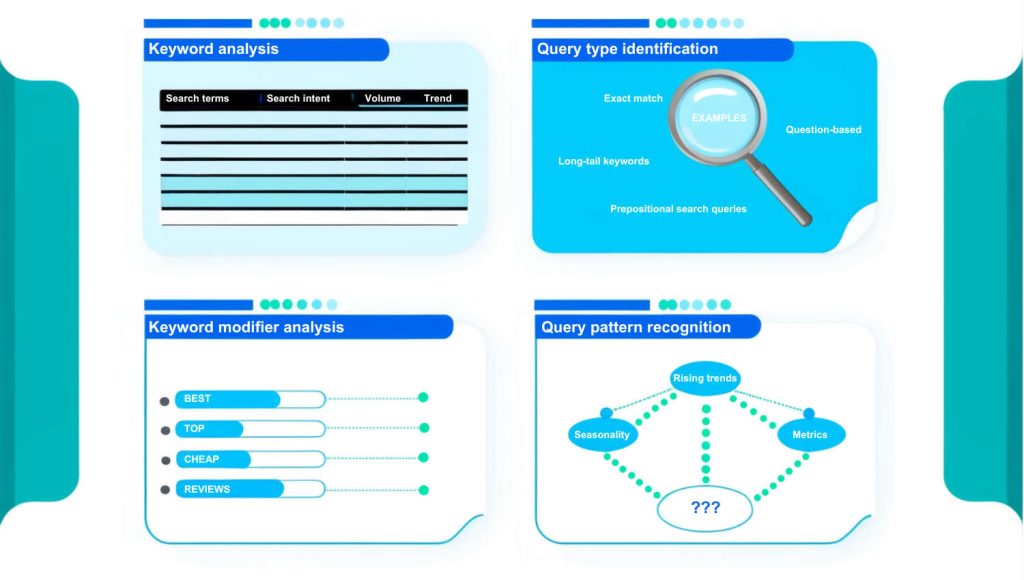
1. Keyword analysis
Start by expanding your keyword list to include variations and related terms. For the query “best home office chairs,” consider these variations:
- “Top home office chairs”
- “Best ergonomic chairs for home office”
- “Most comfortable home office chairs”
Identify the common themes in these keywords, such as a focus on quality, ergonomics, and comfort. This indicates that users are likely seeking detailed product recommendations emphasizing features beneficial for prolonged use in a home office setting.
2. Query type identification
Recognize that “best home office chairs” falls under a commercial query type. Users are researching options to make a purchase decision, so your content should cater to this stage of the buyer’s journey. Provide comprehensive reviews, comparisons, and recommendations to help users evaluate their choices.
3. Keyword modifier examination
Analyze the keyword modifiers in the query:
- “Best” – This modifier highlights that users are seeking top-quality recommendations.
- “Home office” – This specifies the context in which the chairs will be used, emphasizing the need for suitability and functionality in a home office environment.
Use these insights to tailor your content. For example, focus on features that make a chair ideal for a home office, such as adjustability, support, and durability.
4. Query pattern recognition
Examine related queries to uncover emerging trends and specific user needs:
- “Best budget office chairs” indicates that some users are looking for cost-effective options without having to compromise on quality.
- “Ergonomic chairs for long hours” suggests the need for chairs that provide comfort and support for extended periods of use.
Incorporate these insights into your content strategy. Create articles or guides that address different user needs, such as “Top budget-friendly home office chairs” or “Best ergonomic chairs for all-day comfort.”
Implementing your findings
With these analyses, you can craft content that precisely meets user needs:
- Content creation – Develop comprehensive guides or reviews that cover various aspects of home office chairs, including quality, ergonomics, price range, and specific features.
- SEO optimization – Incorporate primary and secondary keywords naturally into your content, headings, and meta descriptions. Use keyword modifiers effectively to enhance relevancy.
- User engagement – Provide actionable advice, detailed comparisons, and user reviews to engage readers and help them make informed decisions.
By applying these methods, you can align your content with what users are actually searching for, improving your SEO performance and user engagement.
In conclusion
Analyzing search queries is crucial for optimizing your content strategy and enhancing user engagement. By understanding different types of queries, such as exact match, long-tail, question-based, and prepositional, you can tailor your content to meet user intent more effectively. Examining keyword modifiers and query patterns helps refine your approach, ensuring your content aligns with emerging trends and user preferences. You can further optimize your content to keep users engaged and improve your SEO performance by leveraging engagement metrics like CTR, bounce rates, and dwell time. Implementing these strategies not only helps attract more targeted traffic but also creates valuable, user-centered content that drives better results.