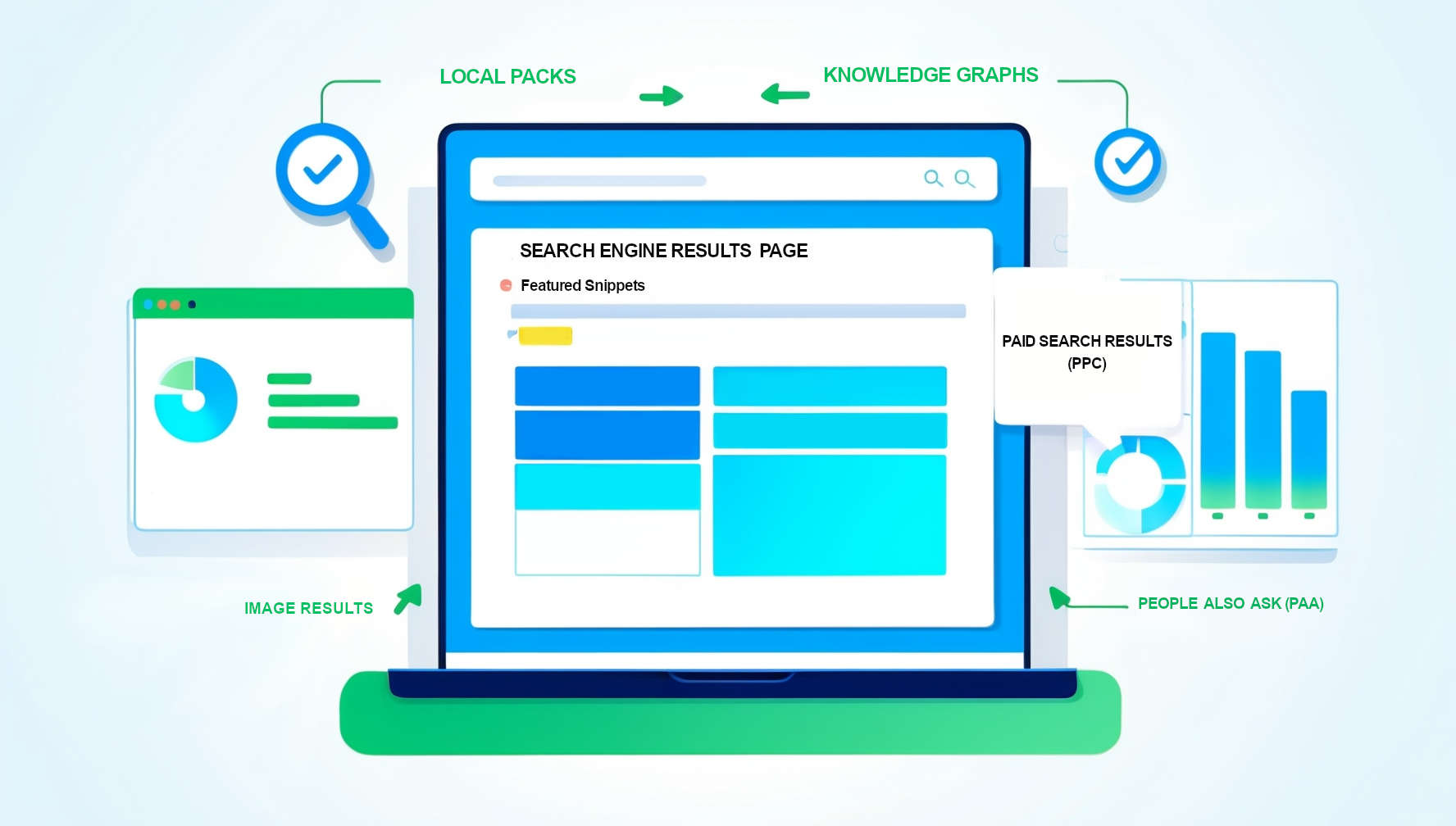
Examining SERPs ((Search Engine Results Pages) is a crucial step in understanding user search intent and optimizing content effectively. The SERP provides valuable insights into what search engines consider relevant for specific queries, and analyzing it helps you adjust your content to meet user expectations. This blog post presents some essential tools and methods for performing SERP analysis, highlights common pitfalls to avoid, and provides actionable insights to help you stay ahead in the competitive online search landscape.
Table of Contents
What is SERP?
SERP is what you see after typing your query into Google or another search engine. The SERP shows a mix of results, including websites, images, videos, and ads. Each result aims to answer your question or provide the information you’re looking for.
Analyzing SERP results is crucial for understanding how your content ranks. It helps you see where you stand compared to competitors. By studying these results, you can identify trends and opportunities to improve your content. This analysis is your key to unlocking higher rankings and more traffic.
Examining SERP results gives you insight into what works and what doesn’t. It helps you spot high-performing keywords and effective content strategies. This information is invaluable for SEO and digital marketing. When you understand the SERP landscape, you can tailor your strategy to meet user intent and stay ahead of the competition. It’s like having a map that guides you to the treasure of higher rankings and better visibility.
Understanding SERP components
Google has many SERP features, but I won’t cover each one in detail here. Instead, here’s a list of the most common ones. You might also see features like “Things to know,” “Discussions and forums,” AI overviews, “From sources across the web,” “Scholarly articles,” “See results about,” and others.
Organic search results
Organic search results are the unpaid listings you see on a SERP, shown based on their relevance to your search query. For example, if you search for “best hiking trails,” you’ll see a list of websites offering information on hiking trails. Google uses complex algorithms to rank these results, considering factors like content quality, keyword usage, and backlinks. The higher your content ranks, the more visibility and clicks it receives. Organic results are vital because they build trust and drive long-term traffic.
Example:
- Search for “best hiking trails”
- Top organic result: An article on “10 best trails and hikes in Trieste” from a reputable travel site.
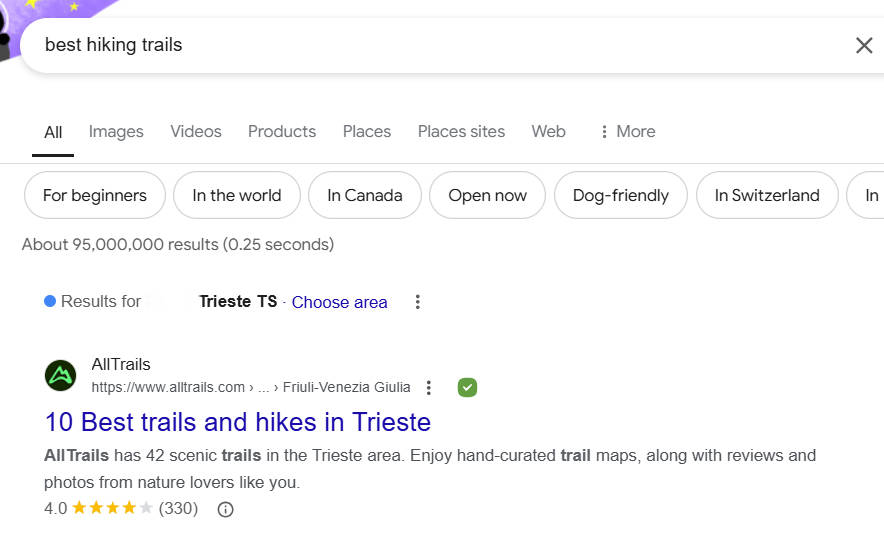
Remember, the results you see will depend on your current location. For example, if you’re in New York, you’ll see search results tailored to the New York area.
For more details, visit Google’s Search Engine Optimization (SEO) Starter Guide.
Paid search results (PPC)
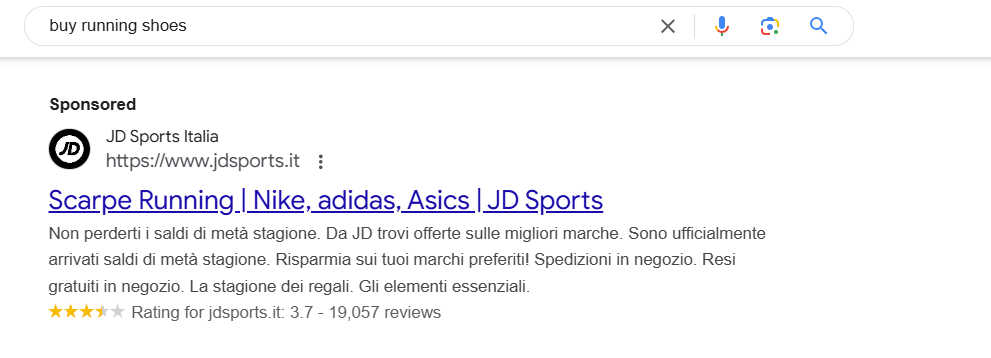
Paid search results, or pay-per-click (PPC) ads, are sponsored listings that appear above or below organic results. Advertisers bid on keywords. Then, their ads appear based on relevance and bid amount. For example, searching “buy running shoes” might display ads from Nike and Adidas at the top of the page. Google Ads is a popular platform for creating these paid listings. Unlike organic results, paid ads offer immediate visibility but at a cost. They are marked as ads, making them distinct from organic results.
Example:
- Search for “buy running shoes”
- Top paid result: An ad from JD Sports’ online store
Learn more about PPC ads on Google Ads Help.
Local pack
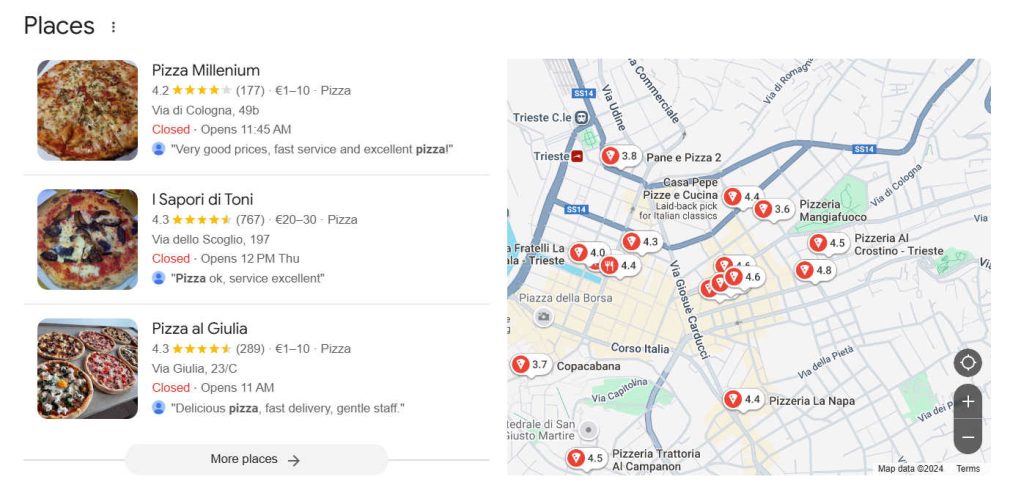
The local pack is a SERP feature that shows local businesses relevant to a search query. It typically shows a map with three business listings, each with ratings, addresses, and contact information. For example, searching for “pizza near me” will trigger a local pack showing nearby pizzerias. Local packs are crucial for businesses targeting nearby customers.
Example:
- Search for “pizza near me”
- Local pack result: Three pizzerias with ratings, addresses, and a map
For more on local packs, check out Google My Business Help.
Featured snippets
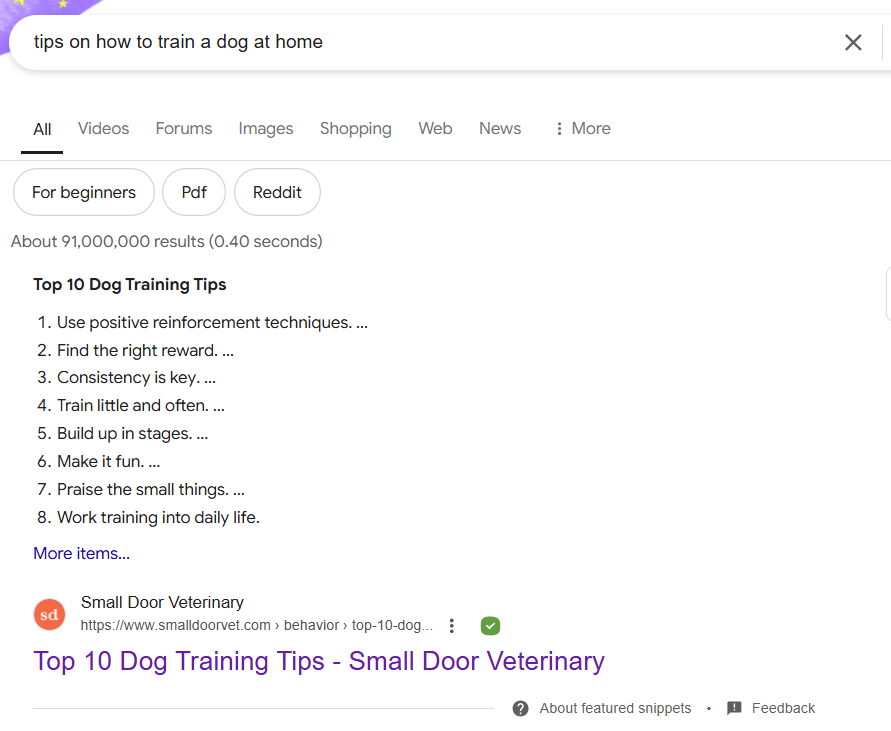
Featured snippets are highlighted answer boxes appearing at the top of some SERPs. They provide concise answers to search queries and come in various formats like paragraphs, lists, and tables. For instance, a search for “tips on how to train a dog at home” might show a step-by-step list right at the top. Featured snippets significantly impact user engagement by offering quick answers, often resulting in higher click-through rates for the featured content.
Example:
- Search for “tips on how to train a dog at home”
- Featured snippet: A list of dog training tips from a website offering veterinary services.
Read more about featured snippets on Google Search Central.
Knowledge graph
Google’s Knowledge Graph is a feature that presents detailed information about people, places, or things directly in the SERP. It pulls data from various sources to provide a comprehensive overview. For users, it means quick access to information without extra clicks, while for businesses, appearing in the knowledge graph boosts credibility and visibility. For example, searching for “Albert Einstein” will show a knowledge graph with a summary, images, and related information.
Example:
- Search for “Albert Einstein.”
- Knowledge graph result: A summary of Einstein’s life, a photo, and key facts

For more on knowledge graphs, visit Google Knowledge Graph.
People Also Ask (PAA)
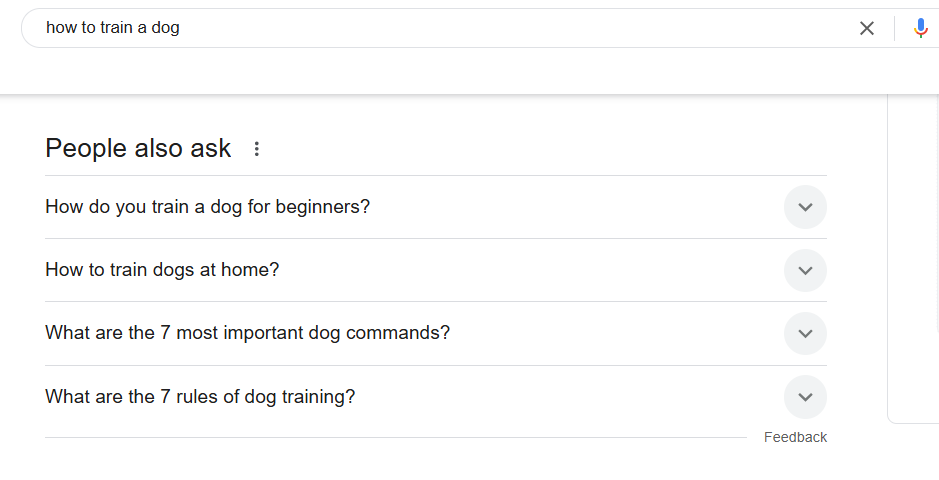
People Also Ask (PAA) boxes are interactive elements showing related questions to the original search query. Clicking on a question reveals a brief answer and more related questions. For instance, a search for “how to train a dog” may include PAA questions like “What is the best age to start training a dog?” PAA influences search behavior by encouraging users to explore further, increasing the chances of discovering your content.
Example:
- Search for “how to train a dog.”
- PAA result: Questions like “How do you train a dog for beginners?” and “What are the 7 rules of dog training?”
Learn about PAA on Google Search Central.
Image and video results
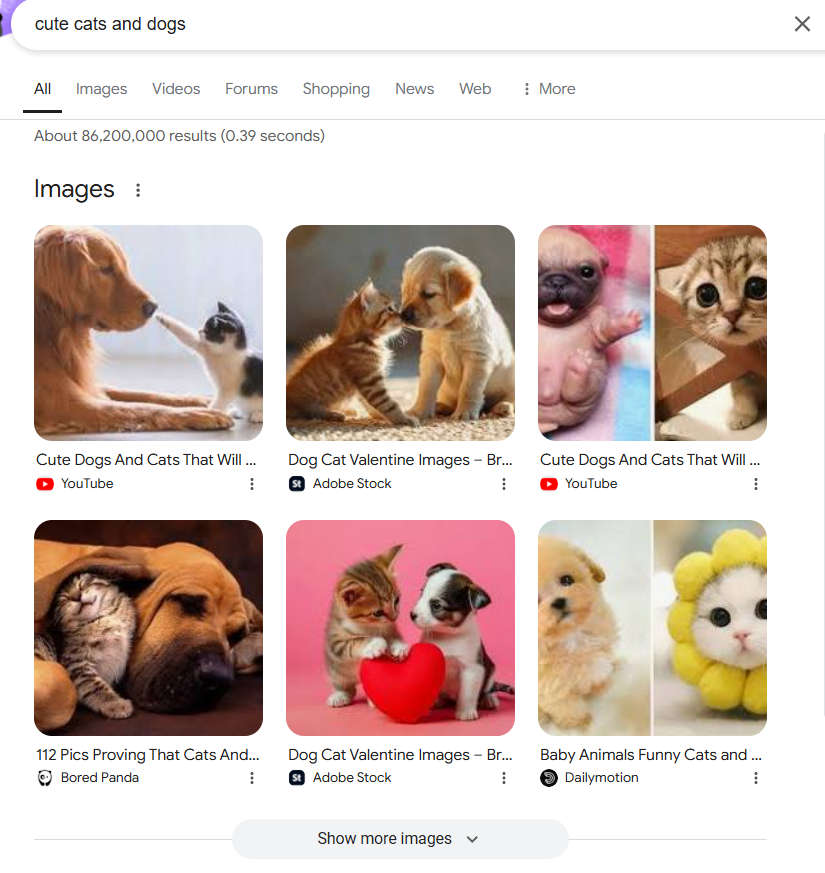
Visual content (images and videos) plays a significant role in SERPs. These results are often displayed in dedicated sections, drawing user attention. For example, searching for “cute cats and dogs” will show a grid of cat and dog images and videos. Including high-quality visuals in your content can improve engagement and ranking. Visual results are particularly important for queries where visual information is more helpful than text.
Example:
- Search for “cute cats and dogs”
- Image and video result: A grid of cat and dog images and videos
Read about visual content in SERPs on Google Images Help.
By understanding these SERP components, you can optimize your content to enhance visibility, engagement, and overall search performance.
Tools for analyzing SERP results
SEO tools
Here is an overview of some popular tools that can significantly enhance your SEO strategy through comprehensive features like keyword research, competitor analysis, and SERP tracking:
- SEMrush – A comprehensive SEO tool that offers keyword research, competitor analysis, and SERP tracking. It helps identify high-performing keywords and tracks your rankings over time. For example, you can use SEMrush to find the top keywords your competitors rank for and analyze their backlink profiles.
- Ahrefs – Known for its robust backlink analysis, Ahrefs also offers keyword research, site audits, and rank tracking. It helps you understand why your competitors are ranking high and what you can do to outrank them. For instance, use Ahrefs to see which websites link to your competitors but not to you and target those for backlinks.
- Moz – Provides tools for keyword research, site audits, and link building. Moz’s SERP analysis features help you understand the competitive landscape and optimize your content accordingly. For example, use Moz’s Keyword Explorer to find keywords that have low competition level but high search volume.
How to use these tools for SERP analysis:
- Keyword research – Identify relevant keywords and analyze their search volume, difficulty, and competition. For example, search for “best coffee makers 2024” and analyze the top keywords related to this query.
- Competitor analysis – Examine the top-ranking pages for your target keywords and analyze their content, backlinks, and domain authority. For example, use SEMrush to see what content format your competitors use (e.g., blog posts, videos) and how you can improve yours.
- Rank tracking – Track keyword rankings over time to see how your optimizations impact your SERP positions. For instance, set up a project in Ahrefs to track your ranking for “best coffee makers 2024” and receive weekly updates.
Automated reporting
Automated SERP reporting offers several significant benefits for managing your search engine rankings. First, it enhances efficiency by automatically collecting and analyzing SERP data, which saves considerable time and effort. Second, this automation ensures consistency by providing regular updates and reliable tracking of your SERP positions. Additionally, automated reporting is highly scalable and capable of handling large sets of keywords and tracking their performance over time.
To take advantage of these benefits, several reporting tools and platforms are recommended:
- SEMrush Position Tracking allows you to monitor your keyword rankings and observe changes over time. For instance, you can set up automated reports to track your daily rankings for keywords like “best coffee makers 2024.”
- Ahrefs Rank Tracker monitors your keywords’ positions in search results and sends regular updates. You could use Ahrefs to receive weekly email summaries of your keyword performance.
- Moz Pro Campaigns offers automated tracking of keyword rankings, site audits, and backlink profiles, enabling you to create campaigns that provide monthly reports on your SEO progress.
By leveraging tools like SEMrush, Ahrefs, and Moz Pro, you can effectively analyze SERP results, understand the competitive landscape, and optimize your content for better rankings and user engagement.
How to conduct a manual SERP features analysis
Let’s use the search query “best coffee makers 2024” as our example. We’ll analyze the SERP features, review the top results, look into ranking factors, and understand user intent based on SERP trends.
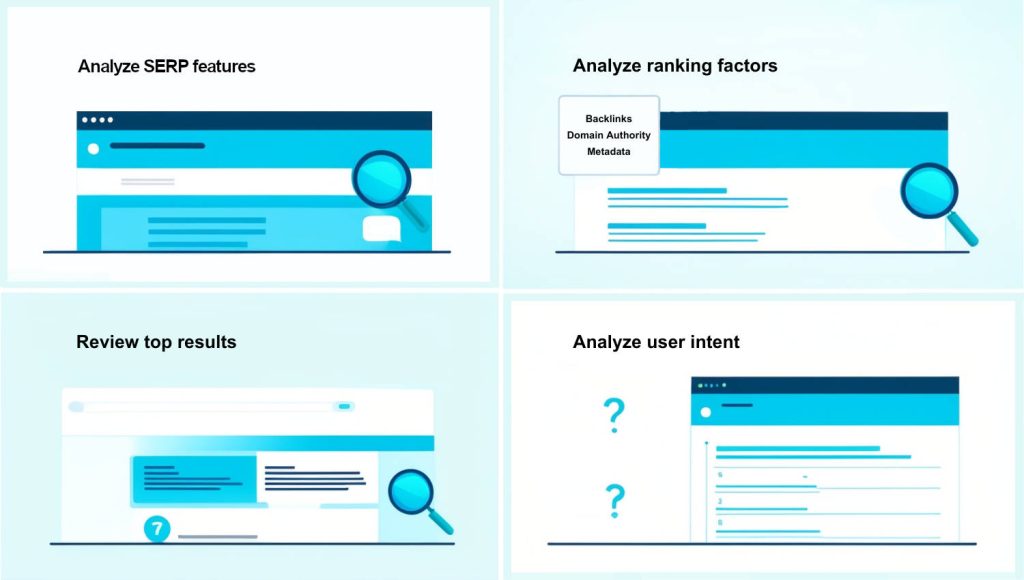
1. Analyze SERP features
First, examine the different types of features appearing on the SERP for “best coffee makers 2024.” Common features include:
- Organic listings – Standard search results ranked based on relevance and SEO.
- Featured snippets – Short summaries of the best coffee makers, often at the top.
- Knowledge panels – Information boxes detailing popular coffee makers or brands.
- Local packs – Maps and listings of local stores selling coffee makers.
- Paid ads – Sponsored results typically at the top and bottom.
- People Also Ask (PAA) – Questions about the best coffee makers.
- Carousels – Collections of images or videos of coffee makers.
Each feature hints at the user’s intent. For example:
- Featured snippets suggest that users want a quick overview of the best options.
- Local packs indicate that users may be looking to buy locally.
- Product listings suggest transactional intent, like making a purchase.
Analyze the content type and format appearing in the top results:
- Blog posts – Detailed reviews and comparisons.
- Videos – Product demonstrations and reviews.
- Product pages – Direct links to purchase coffee makers.
2. Review top results
Next, assess the content quality, depth, and presentation of top-ranking pages:
- How comprehensive is the content? The top articles are usually long, detailed reviews with comparisons and ratings.
- Is the content easy to read and understand? High-quality content typically features clear language, bullet points, and good formatting. No one likes deciphering jargon, so keep it crystal clear.
- Are there images, videos, or infographics? Top pages include images, videos, and infographics to enhance user experience.
Then, take a closer look at the structure of the top-ranking sites:
- Navigation – Easy-to-navigate menus and internal links.
- Mobile optimization – Content looks great on all devices.
- Loading speed – Fast loading times ensure users stay engaged.
Check for user comments, social sharing options, and calls to action. High engagement typically means the content meets user needs.
Spot opportunities to outshine competitors. If top-ranking pages miss specific aspects, create more comprehensive content. For instance, if they lack user reviews or a buying guide, add these elements to your content.
3. Analyze ranking factors
To master on-page SEO, analyze how top-ranking pages use title tags and meta descriptions. Effective titles and descriptions include primary keywords and address user intent. Look at the use of headings (H1, H2, etc.) and subheadings to guide users and search engines through the content.
Consider the domain authority of top-ranking sites. High-authority sites often rank well due to strong backlink profiles and established credibility. Use tools like Ahrefs or SEMrush to analyze the backlink profiles of these pages, focusing on the quantity and quality of backlinks.
Check the loading speed and mobile optimization of top-ranking pages. Tools like Google PageSpeed Insights provide detailed performance metrics. Make sure your content is mobile-friendly, accessible, and easy to navigate, as mobile-friendliness is a key ranking factor.
4. Analyze user intent based on SERP trends
Observe consistent trends for certain types of queries or content formats over time. For instance, if video content increasingly appears for “best coffee makers 2024,” users might prefer visual content.
Based on these insights, adjust your content strategy. If informational content dominates, focus on providing valuable, detailed information. If transactional content is prevalent, optimize your product pages or service offerings to meet user intent.
Consider local and personal factors. If local results are prominent, optimize for local SEO. Remember, SERPs can vary based on location, search history, and personalization. Tailor your content to address the general intent observed in the SERP.
Conducting this detailed SERP analysis will help you better understand how to optimize your content, improve your rankings, and effectively meet user intent.
Advanced SERP analysis techniques
Tracking SERP volatility
SERP volatility refers to the frequency and extent of changes in search engine results pages. High volatility means search rankings fluctuate significantly over short periods. This can indicate algorithm updates, changes in user behavior, or emerging trends.
Here’s a list of tools and methods you can use to track changes:
- SEMrush Sensor measures daily SERP fluctuations across various industries, helping you stay aware of changes that might affect your rankings. For example, use SEMrush Sensor to monitor volatility in the “Technology” category and adjust your strategies if you notice spikes.
- MozCast provides a weather report-like view of Google’s algorithm updates, and it shows their effect on search results. For instance, check MozCast daily to see if significant changes in the search landscape could impact your site’s performance.
- Rank Ranger offers a detailed view of SERP fluctuations, highlighting specific features that have changed. For example, use Rank Ranger to track changes in featured snippets or local packs.
Seasonal trend analysis
Understanding seasonal trends helps you anticipate fluctuations in search behavior and align your content strategy with user interest peaks.
Google Trends can help you identify search trends over time, showing you when specific topics gain popularity. For example, use Google Trends to see if the search volume for “Christmas gift ideas” spikes in November and December. Additionally, use historical SERP data to analyze past SERP performance during peak seasons and understand what content types and keywords performed well. For example, review last year’s data to identify which articles on “best summer travel destinations” ranked highest in May and June.
If you need to adjust your content strategies according to a seasonal trend, here’s what you should do:
- Create and schedule content ahead of seasonal peaks to capture increased search traffic. For example, publish holiday shopping guides in early November to rank in time for the Christmas shopping season.
- Adjust your SEO campaigns to focus on high-volume seasonal keywords. For example, start optimizing your content for “New Year’s resolutions” keywords in December.
Long-tail keywords and niche markets
Long-tail keywords are longer, more specific search phrases with lower search volume but higher conversion rates. They help target niche markets and meet specific user needs.
Here’s a list of common strategies you can use to target a niche market:
- Keyword research – Use tools like Ahrefs, SEMrush, or Ubersuggest to find long-tail search terms relevant to your niche. For example, instead of targeting “coffee makers,” focus on “best coffee makers for small kitchens.”
- Content creation – Develop content that addresses specific problems or needs within your niche. For example, write an in-depth guide on “How to choose the best coffee maker for a dorm room.”
- User intent analysis – Understand the intent behind long-tail searches to create content that directly answers users’ queries. For example, if users search for “eco-friendly coffee makers,” provide reviews and comparisons of sustainable options.
- SEO optimization – Optimize your content for long-tail keywords by including them naturally in titles, headings, and body text. For example, optimize your article on “affordable coffee makers for college students” with relevant keywords throughout.
By employing these advanced SERP analysis techniques, you can stay ahead of changes in the search landscape, capitalize on seasonal trends, and effectively target niche markets with long-tail keywords.
Common mistakes and pitfalls
When diving into SERP analysis, it’s crucial to avoid several common mistakes that can undermine your efforts.
One major mistake is overlooking mobile SERPs. With more people using smartphones to search, analyzing mobile-friendly results is vital. If your site isn’t optimized for mobile, you risk losing a good portion of potential traffic. Mobile users often have different search behaviors and needs, so ensuring a seamless mobile experience can improve your rankings and user engagement.
Another pitfall is ignoring SERP features. These features play a crucial role in visibility and click-through rates. Neglecting to optimize for these features means missing out on prime opportunities to capture user attention. For instance, securing a featured snippet can position your content above all other organic results, drastically increasing traffic.
Additionally, focusing solely on rankings is a common mistake. While high rankings are essential, they don’t guarantee success. You must also consider factors like user intent, engagement metrics, and conversion rates. High-ranking pages that fail to meet user needs or provide a poor experience won’t retain visitors or drive conversions. Thus, a holistic approach that includes analyzing user behavior and SERP features is key to a successful SEO strategy.
In conclusion
By leveraging powerful tools, conducting manual checks, and understanding advanced techniques, you can gain valuable insights into search trends and user intent. Avoiding common pitfalls, such as overlooking mobile SERPs and neglecting SERP features, ensures a comprehensive approach to optimization. Remember, rankings are only one piece of the puzzle; focusing on user experience and engagement is equally important. By continuously refining your strategies based on SERP analysis, you’ll stay ahead of the competition and drive meaningful traffic to your site.